Malawi is facing a worsening food security outlook with vulnerable households in Southern and parts of Central region expected to slip into crisis phase three between October 2026 and January 2027.
The latest Food Security Monitor report from Agra—formerly Alliance for a Green Revolution in Africa—attributes the expected deterioration to reduced household purchasing power, limited agricultural labour opportunities and persistently high food prices.
Much of the remaining southern and central areas is expected to remain stressed, which is phase two of Integrated Food Security Phase Classification (IPC2)—the standardised global scale for measuring the severity of food insecurity, ranging from IPC1 (Minimal/none) to 5 (famine).
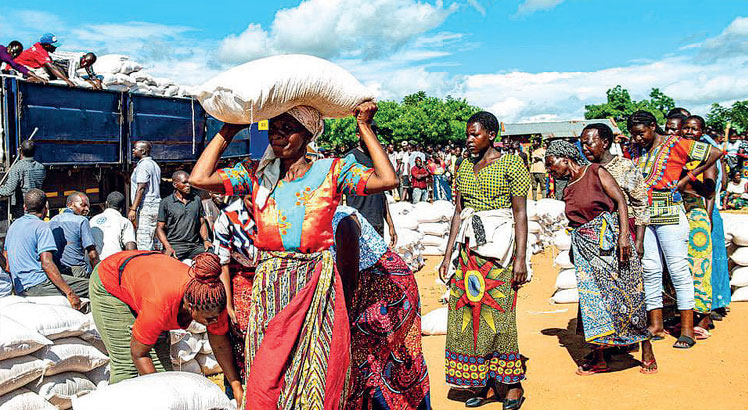
distribution in this file photo. | Nation
Reads the report in part: “Malawi, Mozambique and Zimbabwe are expected to experience increasing food insecurity during the October 2026 to January 2027 lean season, with crisis [IPC Phase 3] outcomes emerging or expanding due to high food prices, weakened purchasing power, declining agricultural labour opportunities and depleted household food stocks.”
Rising food prices are already putting pressure on households that depend heavily on markets. Bean prices increased by 5.8 percent in August amid tight supplies, while rising maize prices continue to constrain food access for market-dependent families.
Farmers are also keeping a close eye on agricultural input costs ahead of the new planting season as the report indicates that fertiliser markets remained broadly stable in August for Southern Africa, although Malawi continued to record significant price increases.
The development comes just days after the International Food Policy Research Institute (Ifpri) maize market report for August indicated that imports of cheaper maize from neighbouring countries are helping contain prices on the domestic market.
Grain Traders Association of Malawi president Grace Mijiga-Mhango said profit margins on imported maize are minimal, but imports are necessary because domestic stocks are low.
Research extension expert Leonard Chimwaza said Malawi needed stricter controls on maize outflows and a stronger domestic production strategy.
“We cannot be relying on grain reserves from other countries year in and out. We need to implement our own production plan and prudent management of the strategic grain reserves,” he said.
Government has allocated K100 billion to National Food Reserve Agency to buy maize while Admarc is expected to receive K60 billion for the same grain.
Admarc spokesperson Theresa Chapulapula recently said the State grain trader was holding about 22 500 metric tonnes of maize to cushion Malawians against possible food shortages during forecasted El Niño conditions.